Thank you for contacting us.
We will respond as soon as possible.

22 09 2026
SUBFLOORS FOR RADIANT SYSTEMS: MAXIMUM SYSTEM OUTPUT AND COMFORT WITH ISOLCAP
In radiant floor systems the subfloor is not a neutral layer: it affects system output, downward heat losses and drying times. A thermal insulating subfloor based on EPS beads such as Isolcap reduces mixing water, limits residual moisture and improves the thermal behavior of the whole build-up.
Emanuele Stabellini – Marketing Manager, Edilteco S.p.A.
The performance of a radiant system does not depend only on the pipes and on the boiler or heat pump that feeds it. It also depends, to an often underestimated extent, on the layers that make up the floor: the subfloor, in particular, directs heat towards the room to be heated or cooled and affects the system’s output. Thinking in terms of a “floor system”, the approach set out in the Italian standard UNI 11944 (Screeds for floors – Design criteria, installation and verification methods), means considering all the layers together and not just the final covering.
The role of the subfloor in the output of the radiant system
In a radiant system, heat must be directed upwards, towards the room, and not lost into the floor slab below. A subfloor with good thermal insulation properties limits downward heat losses and concentrates the useful heat flow in the desired direction.
This translates into two concrete advantages: a larger share of energy actually delivered to the room and a more responsive system. With the growing use of heat pumps, which operate with small temperature differences, the efficiency of the whole build-up becomes even more decisive.
Residual moisture and safe start-up of the system
One of the most frequent risks in radiant systems is linked to the residual moisture in the build-up when the system is switched on for the first time. A subfloor made with too much mixing water retains moisture for a long time, extends waiting times and can generate stresses and cracking when the system is started up.
Thanks to the use of virgin EPS beads of constant size, Isolcap® subfloors require significantly less mixing water than cellular concrete subfloors. The result is lower residual moisture, faster and more controlled drying and safer management of the following stages, including the commissioning of the radiant system.
Dimensional stability and no shrinkage
In a radiant system, the long-term stability of the subfloor is essential: drying shrinkage and loss of thickness can compromise the support of the panels and the flatness of the finished floor. Unlike the air bubbles of cellular concrete, EPS beads keep their size constant during installation and over time.
Isolcap is dimensionally stable and does not bleed water: it does not release water that could interfere with the following layers and is not subject to loss of thickness that would jeopardize the output and service life of the system.
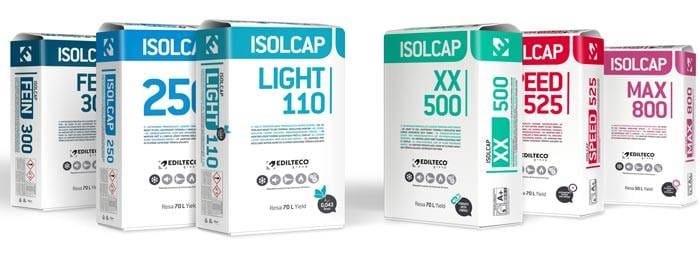
Pre-mixed products of Edilteco’s Isolcap line
Designing the radiant build-up with the Isolcap range
The Isolcap range makes it possible to choose the most suitable subfloor according to the performance required by the build-up: installed density, mechanical strength, available thicknesses and whether or not an acoustic layer is present. In low-thickness build-ups, the Light versions provide very low weight and good insulation even where the available height is limited.
The insulating subfloor also creates the ideal surface on which to lay the radiant panels and embed the pipes, both in heating systems and in radiant floor cooling configurations.
A single system, from the standard to the site
Designing the subfloor of a radiant system as part of the floor system – in line with UNI 11944 and with the indications of EN 1264 for embedded surface heating and cooling systems – means linking thermal insulation, residual moisture, stability and installation times. With Isolcap and the support of Edilteco’s technical department, designers have a consistent range that combines system output, comfort and durability.
SHARE
